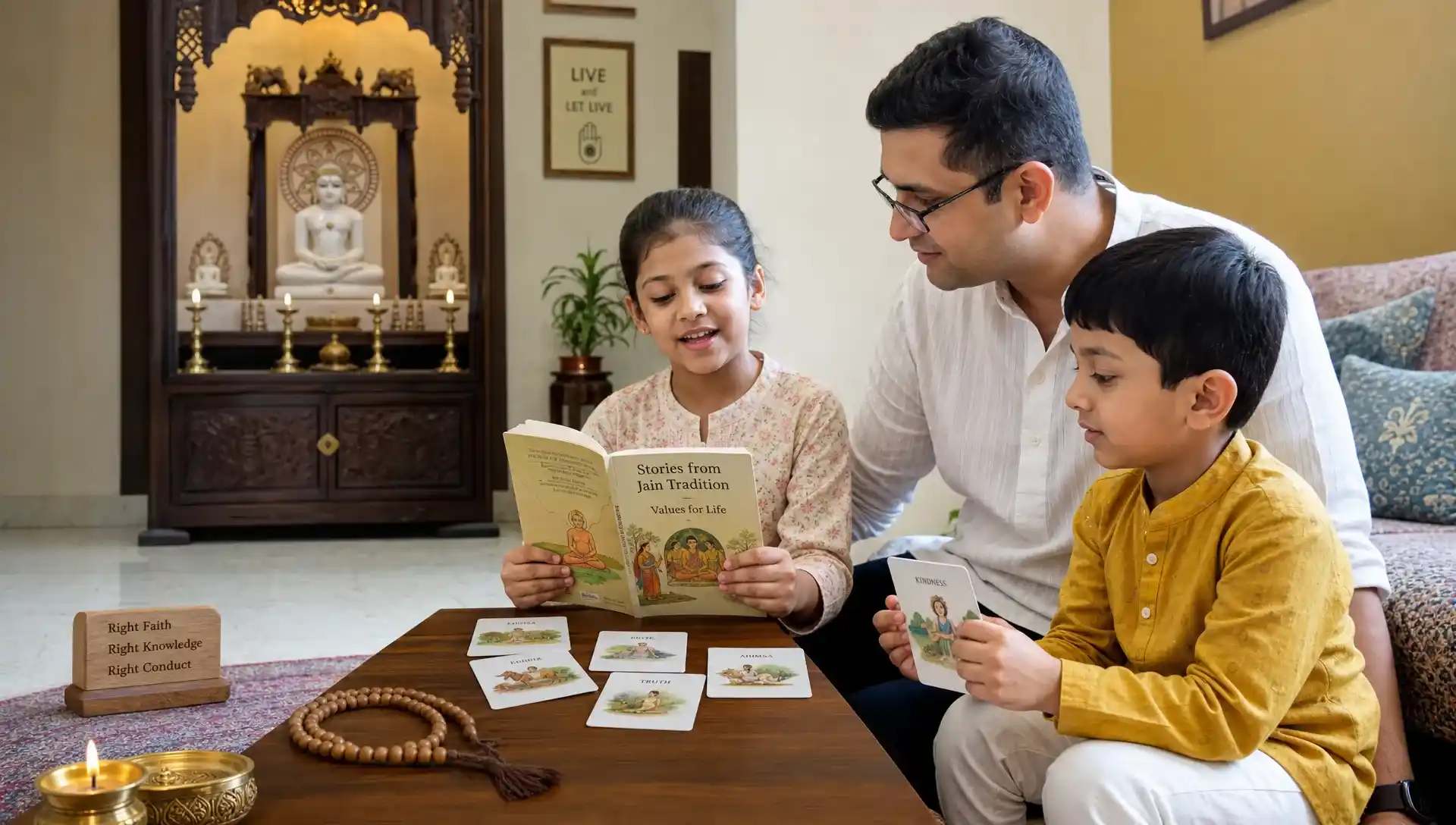
Jainism can feel like a big subject for a child. There are new words, beautiful rituals, temple visits, food practices, stories of Tirthankaras, and deep ideas like karma and moksha. But at its heart, the Jain religion is simple enough for even young children to begin understanding: be kind, speak truthfully, hurt as little as possible, and keep your heart light.
For families, the goal is not to turn every conversation into a lecture. The best way to teach Jainism is through daily life, stories, questions, songs, festivals, and small choices at home. This guide explains the Jain religion in clear language for children and gives parents practical ways to make Jain values meaningful, age-appropriate, and joyful.
What is the Jain religion?
The Jain religion, also called Jainism, is an ancient Indian religion that teaches every living being has a soul and should be treated with respect. Jains believe that the soul can become pure and free by reducing anger, greed, pride, attachment, and harmful actions.
The word “Jain” comes from “Jina,” which means a spiritual victor. A Jina is not someone who wins battles against other people. A Jina is someone who wins over inner enemies such as ego, anger, and desire. This is a powerful idea for children because it turns religion into something practical: the bravest person is not the loudest or strongest, but the one who can choose kindness and self-control.
Jainism is part of India’s spiritual heritage and has been practised for thousands of years. Encyclopaedia Britannica describes Jainism as a religion of India that teaches a path of non-violence and self-discipline. For kids, we can say it even more simply: Jainism helps us live carefully, peacefully, and honestly.
Who are the Tirthankaras?
In Jainism, Tirthankaras are great spiritual teachers who show the path to liberation. They are not creator gods. They are enlightened souls who discovered the truth, lived with complete purity, and taught others how to cross the ocean of worldly suffering.
Jains honour 24 Tirthankaras in the current time cycle. The first Tirthankara is Rishabhdev Bhagwan, also known as Adinath Bhagwan. The 23rd is Parshvanath Bhagwan, and the 24th is Mahavir Bhagwan. Mahavir Bhagwan is often the most familiar to children because many Jain stories, festivals, and lessons focus on his life.
A simple way to explain Tirthankaras to kids is this: “They are like perfect teachers who showed us how to make our soul peaceful, pure, and free.”
When children ask why we bow to them, you can say, “We bow because we respect their qualities. We want to learn from their compassion, courage, forgiveness, and wisdom.”
The main message of Jainism for kids
If you had to explain Jainism in one sentence, you could say:
Jainism teaches us to purify our soul by living with non-violence, truth, self-control, and compassion for all living beings.
That one sentence can become a family reminder. Before speaking, eating, buying, reacting, or arguing, we can ask: “Is this kind? Is this truthful? Is this necessary? Does this reduce harm?”
Of course, children do not need to understand every detail at once. A four-year-old may begin with “do not hurt ants.” A ten-year-old may start asking about karma, fasting, and why Jains eat certain foods. A teenager may explore non-violence in relation to the environment, consumerism, social media, and career choices. Jain learning grows with the child.
The five big Jain values explained simply
The five main vows are followed fully by Jain monks and nuns, and in a smaller, practical way by householders. For children, these values can be taught as daily habits rather than heavy rules.
| Jain value | Simple meaning for kids | Family example |
|---|---|---|
| Ahimsa | Do not hurt living beings | Be gentle with animals, insects, plants, and people |
| Satya | Speak the truth | Tell the truth kindly, even when it is hard |
| Achaurya | Do not take what is not yours | Ask before using someone else’s things |
| Brahmacharya | Use self-control | Learn discipline in thoughts, words, and actions |
| Aparigraha | Do not hold on to too much | Share, donate, and avoid unnecessary wants |
Ahimsa: the heart of Jainism
Ahimsa means non-violence. It is the most well-known Jain value, but it is also one of the deepest. It does not only mean “do not hit.” It also means trying not to hurt through words, thoughts, food choices, carelessness, or selfishness.
For young children, ahimsa can begin with gentle habits: walking carefully, not plucking leaves without reason, giving water to birds, speaking softly, and saying sorry when they hurt someone. Older children can learn that ahimsa also includes emotional kindness, such as not teasing classmates, not spreading rumours, and not using harsh language online.
Satya: truth with kindness
Satya means truth. But Jainism does not teach truth in a rude or careless way. Truth should be spoken with awareness. If a child says, “But I was only telling the truth,” parents can gently explain that truth should not become an excuse to hurt someone.
A useful family phrase is: “Say what is true, say it kindly, and say it at the right time.”
Achaurya: respect for what belongs to others
Achaurya means not stealing. Children can understand this through everyday examples. Taking a sibling’s toy without asking, copying homework, keeping extra change by mistake, or using someone’s stationery without permission are small moments where Jain values become real.
This value also teaches respect for time, effort, and trust. When we take credit for someone else’s work or waste someone’s time carelessly, we are also taking something that is not ours.
Brahmacharya: learning self-control
For kids, brahmacharya can be introduced as self-control and discipline. It means learning to guide our senses, thoughts, and actions instead of being controlled by every desire.
This can apply to screen time, anger, food cravings, bedtime routines, and the way children speak when they are upset. A child who pauses before shouting has practised a small form of self-control.
Aparigraha: keeping life simple
Aparigraha means non-possessiveness or not being attached to too many things. This is especially helpful for modern families, where children are surrounded by toys, gadgets, trends, and constant advertising.
A simple way to teach aparigraha is to ask children to regularly choose items they no longer use and donate them. Another way is to discuss the difference between “need” and “want.” This does not mean children cannot enjoy gifts. It means they learn gratitude, sharing, and balance.
What do Jains believe about soul and karma?
Jainism teaches that every living being has a soul, called jiva. Humans, animals, insects, and even tiny life forms are treated with care because each soul has value. This is why Jains try to be mindful in eating, walking, speaking, and living.
Karma in Jainism is not just a reward-and-punishment idea. It is understood as a subtle matter that attaches to the soul because of our actions, passions, and intentions. When we act with anger, greed, pride, or deceit, we attract karma. When we practise forgiveness, discipline, meditation, and right conduct, we reduce karmic bondage.
For children, karma can be explained like dust on a shiny mirror. The soul is naturally bright and pure, but harmful actions and strong negative emotions cover it. Jain practices help clean the mirror so the soul can shine again.
Moksha means complete freedom of the soul from karma. It is the highest goal in Jainism. Children do not need to understand moksha philosophically at first. You can say, “Moksha is when the soul becomes completely pure, peaceful, and free forever.”
How Jain families practise Jainism at home
Jain practice can look different from family to family. Some families visit the temple daily, while others go on special days. Some children learn sutras early, while others begin with stories and values. Some households follow stricter food practices, while others introduce them gradually. The important thing is to keep learning respectful and consistent.
Common Jain practices include saying the Navkar Mantra, doing puja, listening to stavans, observing fasting or simple food days, reading stories of Tirthankaras, practising pratikraman, and celebrating festivals such as Paryushan, Mahavir Janma Kalyanak, and Ayambil Oli.
| Practice | Kid-friendly explanation | How families can introduce it |
|---|---|---|
| Navkar Mantra | A prayer that bows to pure souls | Recite slowly and explain one line at a time |
| Puja | Showing respect and devotion | Let children observe, ask questions, and participate gently |
| Pratikraman | Saying sorry and reflecting | Use a short bedtime reflection for younger kids |
| Fasting | Practising discipline | Start with simple limits only when age-appropriate |
| Paryushan | A time for forgiveness and inner cleaning | Focus on Michhami Dukkadam, stories, and kindness |
How to explain Jainism by age
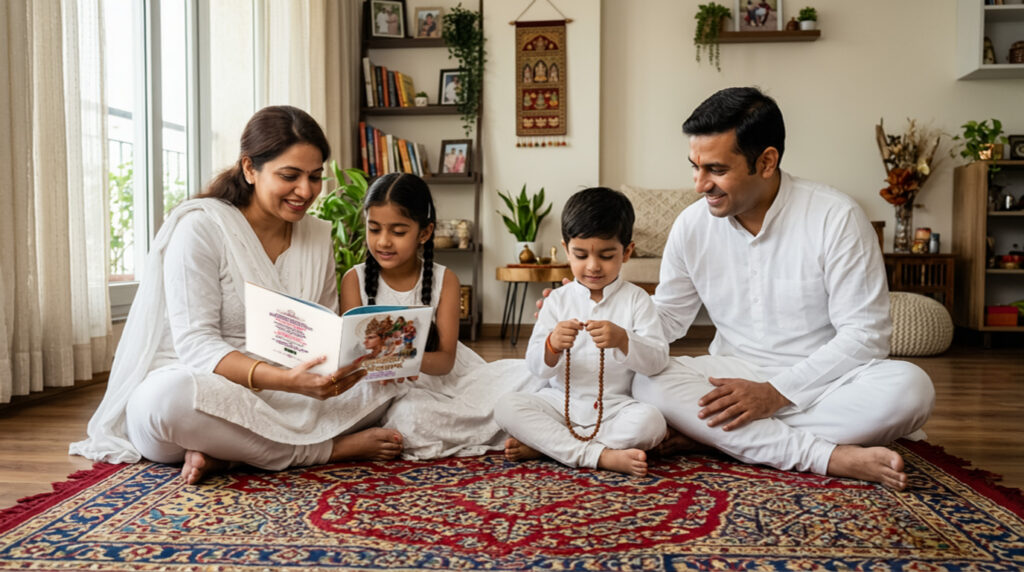
Children learn best when the explanation matches their age. A toddler does not need a lecture on karma theory, and a teenager may need deeper answers than “because our religion says so.” Here is a simple guide.
| Age group | What to focus on | Helpful approach |
|---|---|---|
| 3 to 5 years | Kindness, prayer, gentle behaviour | Stories, songs, pictures, simple temple visits |
| 6 to 8 years | Ahimsa, truth, sharing, basic Tirthankara stories | Activity cards, short books, role-play |
| 9 to 12 years | Karma, vows, festivals, food choices | Discussions, quizzes, family reflections |
| 13+ years | Philosophy, ethics, modern life, identity | Open conversations, debates, deeper reading |
For very young children, start with visible actions: folding hands, saying Jai Jinendra, not hurting insects, sharing toys, and listening to short stories. For primary school children, connect Jain values to school life. What does satya mean during exams? What does ahimsa mean when friends gossip? What does aparigraha mean when everyone wants the latest thing?
For teenagers, invite questions. They may ask why Jains fast, why some Jains avoid root vegetables, whether Jainism is scientific, or how non-violence works in a competitive world. Honest conversation is better than forced agreement. Jain philosophy is rich enough to handle thoughtful questions.
Simple activities to teach Jain values at home
The best Jain learning often happens in small family moments. You do not need a perfect classroom setup. You need repetition, warmth, and examples children can see.
- Create a kindness jar where children add a note whenever they practise ahimsa.
- Choose one “truth moment” each week where family members share something honestly and kindly.
- Keep a donation box for toys, books, or clothes as a practice of aparigraha.
- Read one short Jain story before bedtime and ask, “What quality did this teach us?”
- During Paryushan, help children say Michhami Dukkadam with understanding, not just as a phrase.
- Use food conversations to discuss care for living beings without creating fear or guilt.
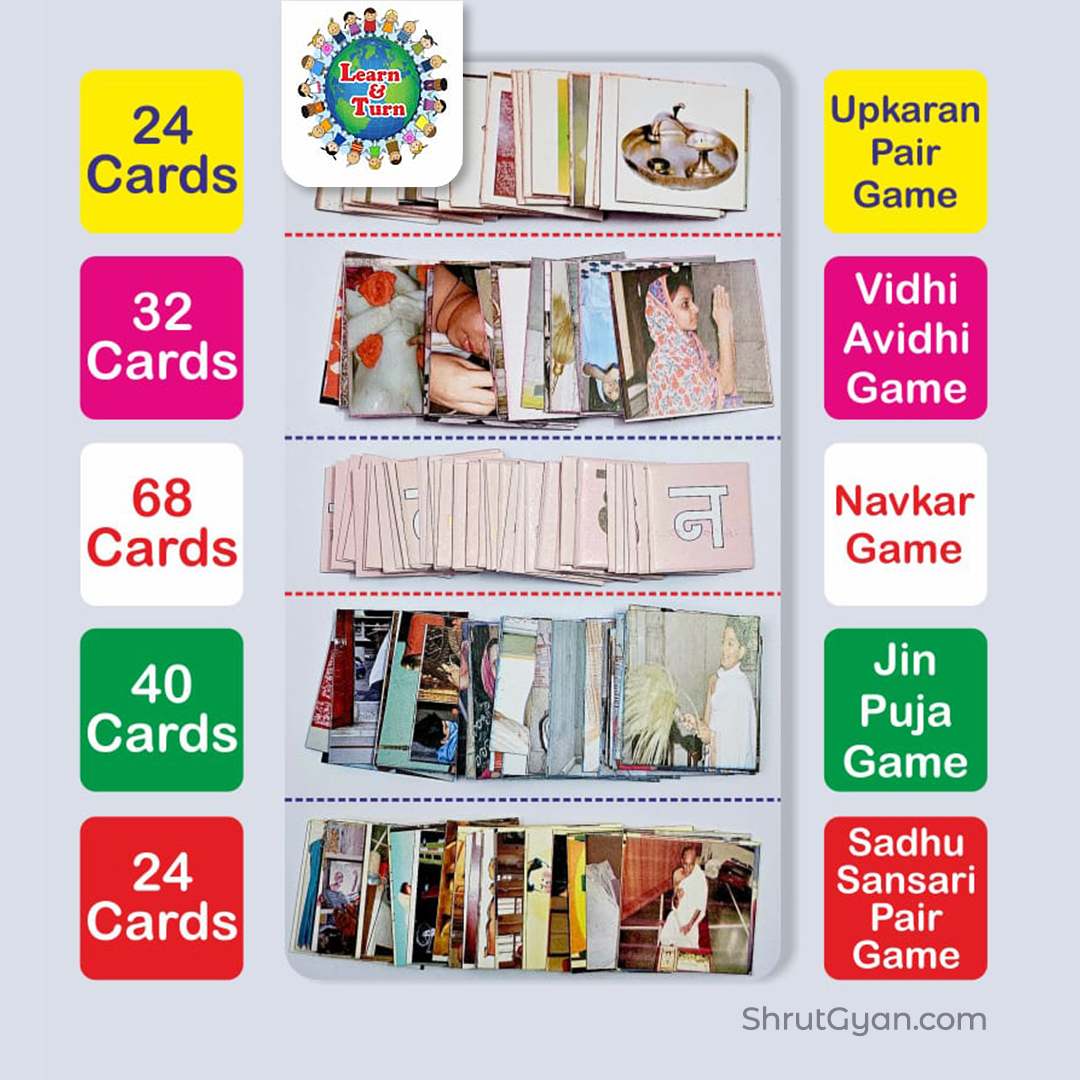
Parents can also use books and games to make learning more engaging. For example, a children’s Jain learning book like My Lord can help introduce devotion and spiritual ideas in English, while a book such as Dwidal can support conversations around ahimsa in a child-friendly way.
How to answer common children’s questions
Children often ask direct questions, and Jainism becomes more meaningful when adults answer with patience.
If a child asks, “Why do we say Jai Jinendra?” you can say, “It means we are honouring the Jinas, the pure souls who won over anger, greed, and ego. It reminds us to bring out good qualities in ourselves.”
If a child asks, “Why do we not hurt even tiny insects?” you can say, “Because Jainism teaches that all living beings want to live. We may not be perfect, but we try to be careful and reduce harm.”
If a child asks, “Why do people fast?” you can say, “Fasting is a way to practise self-control and remember that the soul is more important than taste. Children should only do what is safe and suitable for their age, with guidance from parents.” For families who want to explain the deeper meaning behind practices like fasting, the book Secrets of Jainism can be a helpful way to introduce Jain ideas in a thoughtful and accessible manner.
If a child asks, “Do I have to know every sutra?” you can say, “Learning sutras is beautiful, but understanding their meaning and living with kindness is also very important. We learn step by step.” When children are ready to practise and understand more, families can explore Jain Sutra books together and choose resources that match the child’s age and learning level.
Teaching Jainism without fear or pressure
One of the biggest challenges for families is teaching religion in a way that feels loving rather than stressful. Children should not feel that Jainism is only about restrictions. They should experience it as a path of compassion, wisdom, courage, and inner peace.
Instead of saying, “You are bad if you do this,” try saying, “Let us think about how we can reduce harm.” Instead of comparing children with others, focus on their progress. Instead of forcing long rituals too early, build small habits that grow naturally.
A Jain home does not become spiritual only through rules. It becomes spiritual through the tone of speech, the way elders treat one another, how the family handles mistakes, and whether children see adults practising forgiveness. Children learn Jainism most deeply when they see it lived.
Jain festivals as learning opportunities
Festivals are a wonderful way to make the Jain religion memorable for kids. Paryushan teaches forgiveness, self-discipline, and reflection. Mahavir Janma Kalyanak teaches children about the life and values of Mahavir Bhagwan. Ayambil Oli teaches devotion, simplicity, and discipline through food and worship.
During festivals, families can combine rituals with explanation. A child may remember a story, a craft, a quiz, a gift, or a family conversation more than a long sermon. If you want more ideas for Jain learning, gifting, and celebrations, the Shrut Gyan blog shares family-friendly Jain content throughout the year.
The aim is to help children connect festivals with values. Paryushan is not only about fasting. It is about forgiveness. Mahavir Janma Kalyanak is not only a celebration. It is a reminder to practise fearlessness, compassion, and truth. Ayambil Oli is not only about food discipline. It is about devotion and inner focus.
A simple family summary of Jainism
Here is a child-friendly summary you can repeat at home:
“Jainism teaches that every soul is special. We should try not to hurt anyone, speak the truth, take only what is ours, control our desires, and not become too attached to things. The Tirthankaras showed us how to make our soul pure and peaceful. Every day, we can take small steps toward kindness, forgiveness, and self-control.”
That is enough for a child to begin. Over time, the details can grow. First comes love for the values. Then comes deeper understanding.
Frequently Asked Questions
What is the Jain religion in simple words? The Jain religion is an ancient Indian religion that teaches non-violence, truth, self-control, compassion, and freedom of the soul from karma.
Who is Mahavir Bhagwan? Mahavir Bhagwan is the 24th Tirthankara of Jainism. He taught the path of ahimsa, truth, non-attachment, discipline, and spiritual liberation.
What is the most important Jain value for kids to learn first? Ahimsa is usually the best starting point. Children can understand it through gentle behaviour, kind words, caring for animals, and avoiding unnecessary harm.
Do Jain children need to fast? Fasting should always be age-appropriate and guided by parents. Young children can begin with simple practices like eating mindfully, reducing favourite treats for a day, or learning the meaning behind fasting.
How can parents make Jainism interesting for kids? Use stories, songs, questions, games, festival activities, visual learning, and real-life examples. Children connect best when Jain values feel practical and joyful.
Make Jain learning a part of everyday family life
Explaining the Jain religion to kids does not require perfect knowledge or complicated lessons. Start with one value, one story, one prayer, or one thoughtful question at a time. When children see Jainism as a living path of kindness and wisdom, they are more likely to carry it with love.
Shrut Gyan offers Jainism-inspired books, games, flashcards, puzzles, and learning resources for children and families. Explore Shrut Gyan to find age-appropriate ways to make Jain values easier, warmer, and more engaging at home.